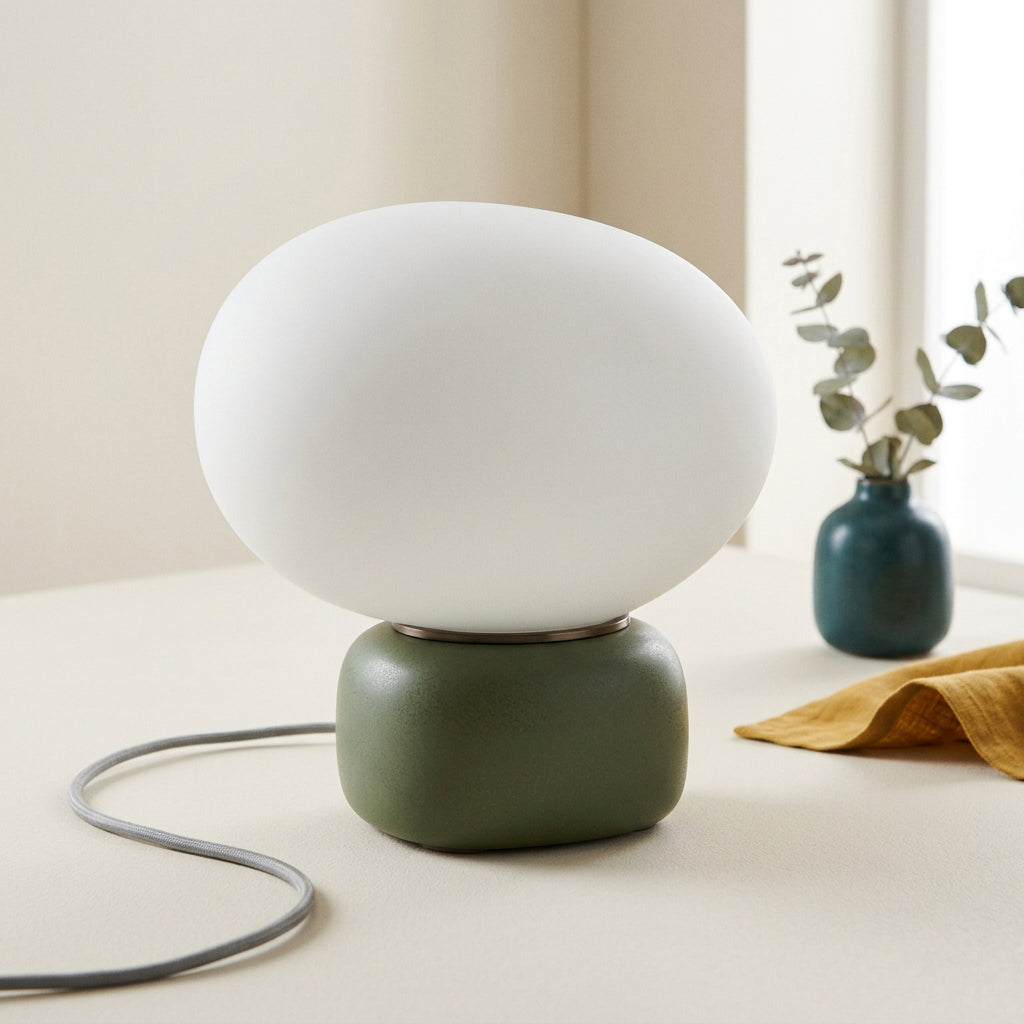
PEBBLE — Organic Ivory Accent Lamp with an Asymmetric Opal-Look Shade and Moss Green Rounded Base
PEBBLE — Organic Ivory Accent Lamp with an Asymmetric Opal-Look Shade and Moss Green Rounded Base
Couldn't load pickup availability

PEBBLE — Organic Ivory Accent Lamp with an Asymmetric Opal-Look Shade and Moss Green Rounded Base
Not Every Beautiful Shape Needs a Straight Line 🍃
PEBBLE takes its visual cue from a softly rounded stone rather than a conventional lampshade. Its ivory upper form is wider than it is tall, with an asymmetric contour that makes one side feel a little fuller than the other. Beneath it sits a moss green base with rounded corners and a narrow darker joining line. The design feels grounded without becoming heavy in appearance, and expressive without needing a sharply sculpted outline. It is an accent for spaces where natural-looking curves, quiet color, and everyday comfort are more important than perfect visual symmetry.

What Makes the Shape Feel Organic?
The upper outline does not trace a perfect circle or a regular oval. Its curve rises and falls gently, creating a small change in emphasis from one side to the other. That imbalance is the defining visual detail, not an imperfection to hide. Seen at a three-quarter angle, the shade reveals a fuller volume behind the front outline. From a different direction, the lower edge becomes more apparent. Give the object room to be seen as a whole, rather than placing it behind a taller accessory that turns the asymmetric silhouette into an indistinct pale patch.

Why the Base Is More Than a Support
Moss green gives the composition a darker center of gravity beneath the pale shade. The base's rounded corners continue the softness of the upper form without duplicating its irregular outline. Where the two parts meet, a narrow bronze-tone line creates a defined visual boundary. That small contrast prevents the ivory and green from blending into one undifferentiated shape. In the detail view, notice how the edge travels around the connection while the broader surfaces remain relatively quiet. The design offers enough definition to feel considered, but avoids adding ridges, decorative feet, or multiple colors at the bottom.

An Ivory Surface with Room for Light
The opal-like appearance of the shade creates a broad area for gentle tonal changes rather than sharp, repeated reflections. In the illuminated scene, the center appears warmer while the outer contour remains readable. In daylight, the pale surface lets the pebble-like form itself take the lead. This difference is worth considering when styling the room. A textured wall can make the smooth-looking shade stand apart; a plain wall emphasizes its irregular outline. Neither approach needs additional ornament on the lamp. The interest comes from volume, color, and the relationship between the rounded top and darker base.

For the Bedside You Actually Use
A low wood surface, cream linen, and one familiar book make a natural starting point. PEBBLE's broad upper form introduces a horizontal curve that can sit comfortably beside the softer shapes of bedding. Keep everyday items low enough that they do not cross the outline of the shade. A small dish can hold a place in the composition, but it does not need to match the green base. The room should feel ready to be used rather than staged for a single photograph. Let the lamp provide the sculptural detail and allow personal objects to keep their practical role.

For a Living Room with More Color
Against dusty peach, the moss base becomes a deeper counterpoint while the ivory shade connects to lighter textiles elsewhere in the room. A walnut sideboard adds another warm layer underneath. Choose a terracotta bowl if you want a related but not identical accent, and keep enough space between the bowl and lamp for both profiles to remain visible. If artwork hangs nearby, try a composition in which the shade sits against a quiet area rather than directly in front of a busy section. The organic outline is easiest to appreciate when its immediate background is not competing for attention.

For a More Restrained Interior
Use the same lamp with natural linen, soft gray, and pale oak for a calmer result. The moss base can remain the only darker color on the surface, giving the arrangement definition without making it dramatic. Introduce texture through a woven fabric or a softly patterned rug rather than placing several textured objects beside the shade. This preserves a clear contrast between the lamp's smoother-looking surfaces and the surrounding room. A little asymmetry in the arrangement can echo the shade: position the lamp off-center, then balance it with one lower object rather than an identical piece on the opposite side.

A Thoughtful Presentation, Kept Simple
The gallery includes a packaging presentation in muted green with a pale fitted insert, showing how the rounded lamp can remain the focus without printed branding or elaborate ribbons. Consider this a visual presentation concept; supplied packaging should be checked against the actual product offering. The palette itself offers a useful styling idea for the home: green beneath, ivory above, and very little additional decoration. Whether you are choosing a piece for your own bedside or considering a personal gift, start with the recipient's existing colors and favorite shapes rather than trying to recreate a complete room from a photograph.

Look at the Unlit Form Before Choosing Its Place
The daylight view makes the asymmetry especially useful to study. Notice where the upper curve is fullest, how it narrows toward the opposite side, and how the smaller base sits beneath it. Think about which angle you will see most often from the doorway, sofa, or bed. An object with an irregular outline can feel different when seen from a slightly different position, even though nothing about the product has changed. Try placing it where both the pale shade and the green foot remain visible, rather than allowing one part to disappear into a similarly colored background.
Leave the Arrangement a Little Unfinished
The appeal of a nature-inspired form is not that it looks perfectly calculated. PEBBLE works best when the surrounding objects feel chosen over time: a book with a plain cover, a bowl with a different curve, a textile that is softly folded rather than arranged into exact lines. Keep those pieces distinct and leave a little clear surface around the lamp. The ivory and moss already provide a complete color relationship, so another accessory is optional rather than necessary. Let the softer silhouette make the room feel more personal, with enough visual space for the smallest details to be noticed.