SOLEN — Sculptural Ochre Cradle Accent Lamp with an Opal Globe and Open Curved Frame
SOLEN — Sculptural Ochre Cradle Accent Lamp with an Opal Globe and Open Curved Frame
Couldn't load pickup availability

SOLEN — Sculptural Ochre Cradle Accent Lamp with an Opal Globe and Open Curved Frame
A Small Sun, Held in a Beautiful Frame 🟡
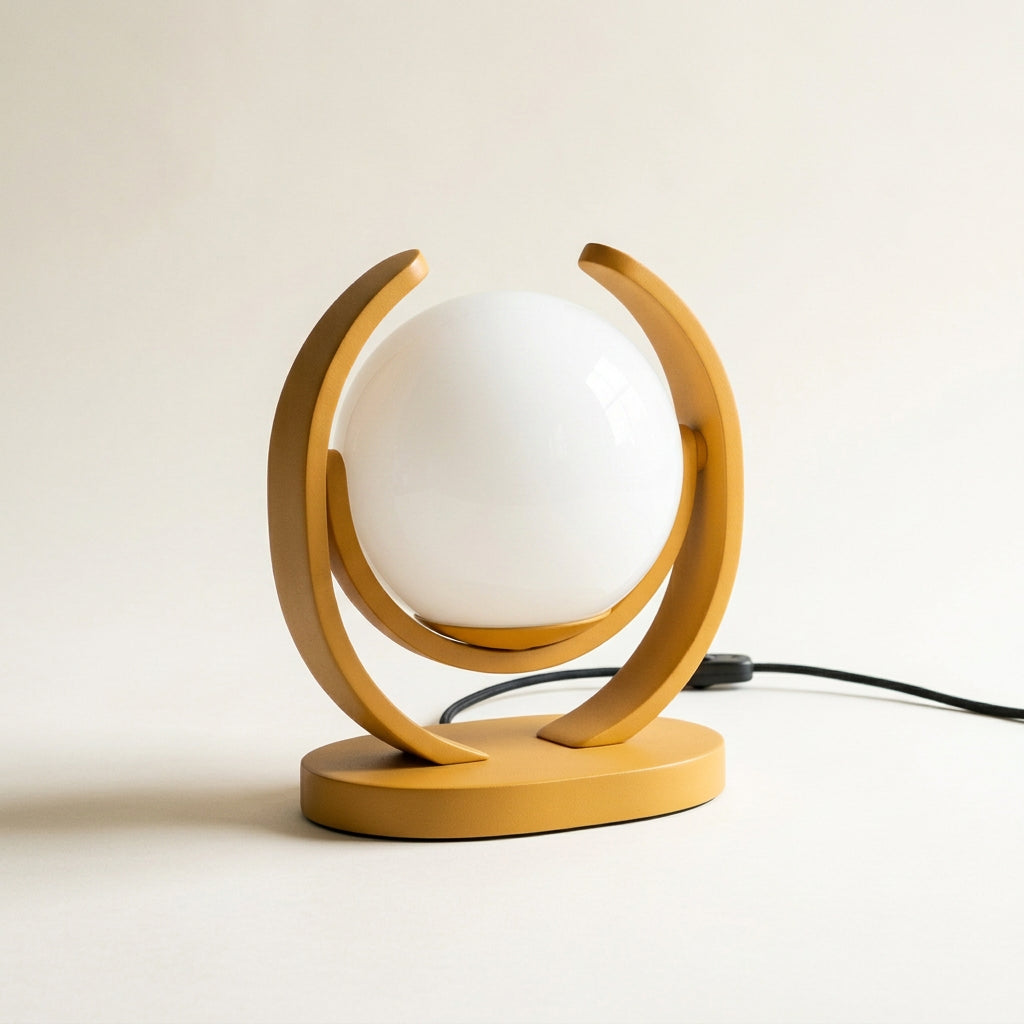
SOLEN begins with a simple contrast: a pale rounded globe surrounded by a richer ochre outline. The sphere brings softness, while the open curved supports give the composition direction and structure. Instead of hiding the light beneath a conventional shade, the design makes the illuminated form the centerpiece. There is a sense of an object being held rather than merely placed on a stand. It is expressive enough to lead a bedside arrangement, yet its restrained combination of colors leaves room for the furniture, textiles, and personal objects around it to retain their own character.

First, Notice What Is Not There
The open spaces around the globe are as important as the colored frame. They allow the wall behind the lamp to remain visible and stop the silhouette from becoming one solid block. A plain background makes each curved arm easier to follow from its lower attachment toward its open end. The globe is visually separate from those outer lines, creating depth rather than a flat graphic symbol. Give the outline a little breathing room on either side. When neighboring objects do not cross those openings, the relationship between sphere, frame, and background becomes much clearer.

Follow the Curves Downward
The curved supports rise from a low ochre base and turn inward around the pale shade. Their upper ends remain visibly open rather than joining into a complete ring. Below the globe, a cradle-like curve continues the sense of support and gathers the composition toward its center. The foot stretches horizontally, providing a visual counterweight to the upright arcs. Notice how the same color connects these elements without making their shapes identical. Each curve has a role: the outer lines define the silhouette, the lower cradle emphasizes the globe, and the base establishes the ground beneath them.

Two Surface Languages, One Composition
The shade has an opal-like appearance, with a broad, softly modeled surface rather than fine facets or pronounced ridges. Beside it, the ochre frame reads as a more defined band of color, with visible edges and changes in reflection along the curves. That difference gives the eye two kinds of detail to explore. The globe is about continuous volume; the supports are about contour and direction. Keeping the palette limited allows those differences to matter. There is no need for a printed pattern, decorative trim, or contrasting ornament to explain the character of the design.

At the Bedside: Warm Color Against a Cooler Wall
A muted blue background sets up a particularly clear relationship with ochre. The cool wall gives the yellow room to stand out, while cream bedding repeats the pale globe at a larger scale. Use a wood bedside surface to connect those elements with a warmer middle tone. Position everyday objects forward of the lamp rather than directly in front of the sphere. A closed book can remain part of the arrangement without interrupting its silhouette. The aim is a useful, lived-in corner with a clear focal point, not a tabletop cleared of everything that makes it personal.

On a Console: Let the Globe Be the Roundest Shape
For a different interpretation, try SOLEN against dusty rose and pair it with a shallow cream bowl. The bowl introduces a lower curve while leaving the globe as the dominant rounded volume. Keep a visible gap between the two pieces, so the arrangement reads as a conversation rather than a cluster. A pale oak surface gives the setting a lighter character than walnut does. If artwork hangs above, allow its lower edge to remain visually separate from the lamp's upper arcs. This small separation helps both objects retain their own boundaries.

Beside a Favorite Chair
An olive textile introduces a deeper, quieter companion to the ochre frame. Against that background, the pale globe becomes a point of contrast rather than another dark decorative object. A side table with a simple top works well because it does not add competing shapes beneath the open supports. Keep the space around the cord considered, with the visible route directed toward the back of the arrangement. The lamp's role in this scene is to add a sculptural accent within the room's lighting composition. Dedicated reading requirements should be addressed separately rather than inferred from the styling photograph.

The Same Silhouette in Daylight
The unlit view shifts attention from the bright center to the physical outline. Look at how the ochre arcs frame the pale globe without closing over it, and how the low base repeats their color beneath the opening. In daylight, the lamp can be considered alongside a bowl or small sculpture as an object with its own proportions. This is useful when choosing a place you see throughout the day. Imagine the unlit form against your actual wall color, not only the illuminated version against a dim background. Both appearances belong to the room.

A Palette You Can Make Your Own
Start with one relationship you already have at home. Ochre can connect to a warm-toned print, the pale globe to an ivory throw, or the curved outline to a rounded chair back. You do not need to repeat all three. For a calmer scheme, use cream, walnut, and muted blue. For more color, introduce dusty rose or olive in a smaller neighboring area. Leave at least one broad surface visually quiet so the curves remain legible. The strongest arrangement is often the one with one deliberate echo and several things that feel naturally collected.
Make the Corner Feel Complete, Not Crowded
Before adding a final accessory, step back and follow the outline with your eyes. Can you see both upper ends of the frame? Does the globe remain distinct from the wall and objects behind it? Is the base visible enough to give the composition a clear beginning? These simple questions help you edit the arrangement without making it austere. SOLEN offers a warm-colored focal point through its open geometry and rounded center. Let those qualities do most of the decorative work, then add one object that makes the corner unmistakably yours.